



Monolith
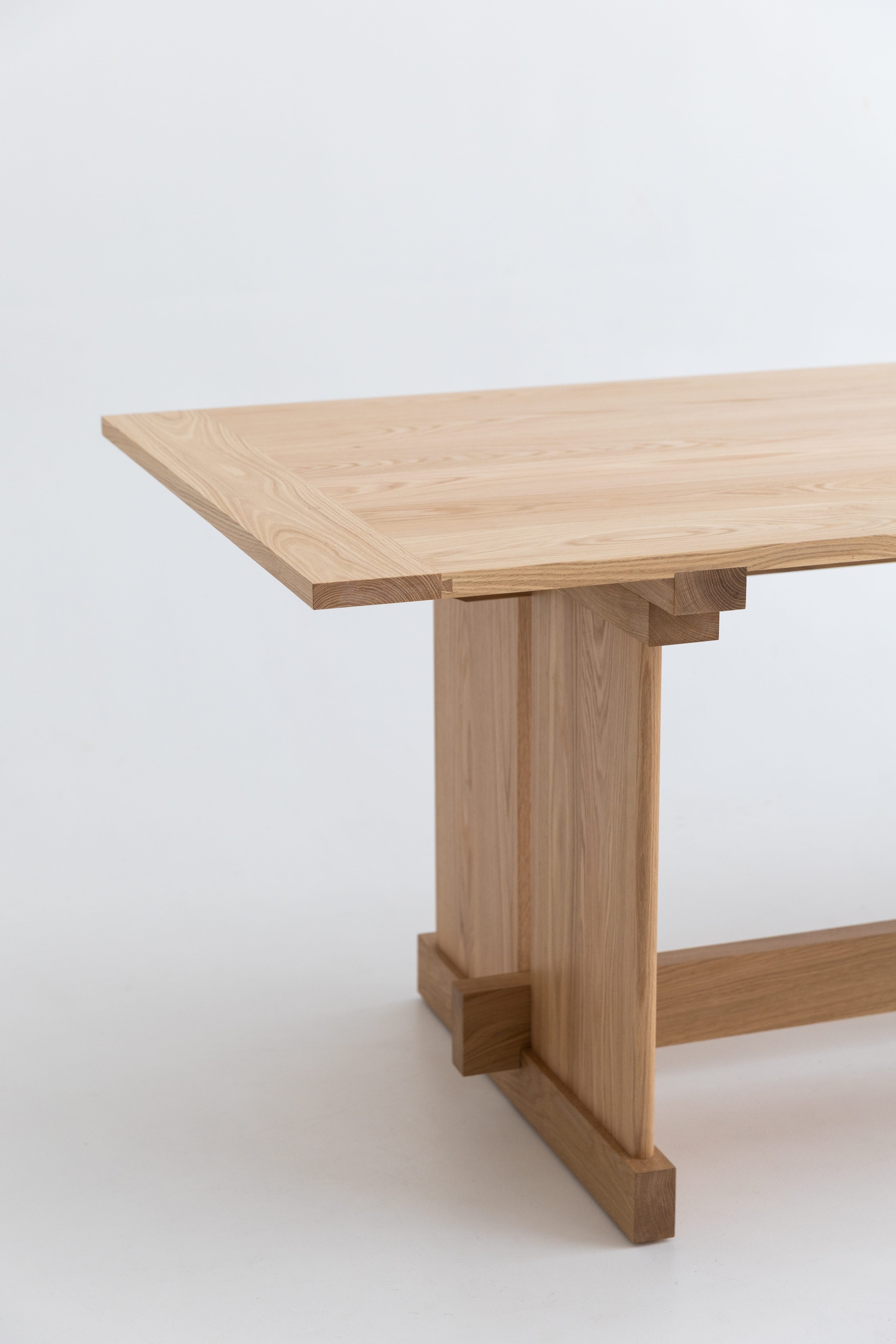
Monolith stands on vertical slabs of solid oak rather than legs. The reference is the residential towers of Šeškinė in Vilnius, where the designer grew up — buildings whose facades are dominated by concrete fins running unbroken from ground to roof, with everything else set back between them. The table works the same way: the slabs are the primary form, and the top is carried rather than supported. No bevels, no profiling, nothing added whose purpose is to show that work was done. The form is held by proportion and mass alone. Solid oak changes what that severity does — the grain runs where the tree put it, the surface warms under a hand, and the timber moves with the seasons. Concrete does none of that, and the difference is the point. Made to order in solid oak. Most pieces ship in 4–8 weeks. We ship worldwide. Delivery is quoted separately once we know where the piece is going — within the EU it is typically €100–250 depending on the location.
2 950,00 €
Description & origin
Monolith
Monolith stands on vertical slabs of solid oak rather than legs. The reference is the residential towers of Šeškinė in Vilnius, where the designer grew up — buildings whose facades are dominated by concrete fins running unbroken from ground to roof, with everything else set back between them. The table works the same way: the slabs are the primary form, and the top is carried rather than supported.
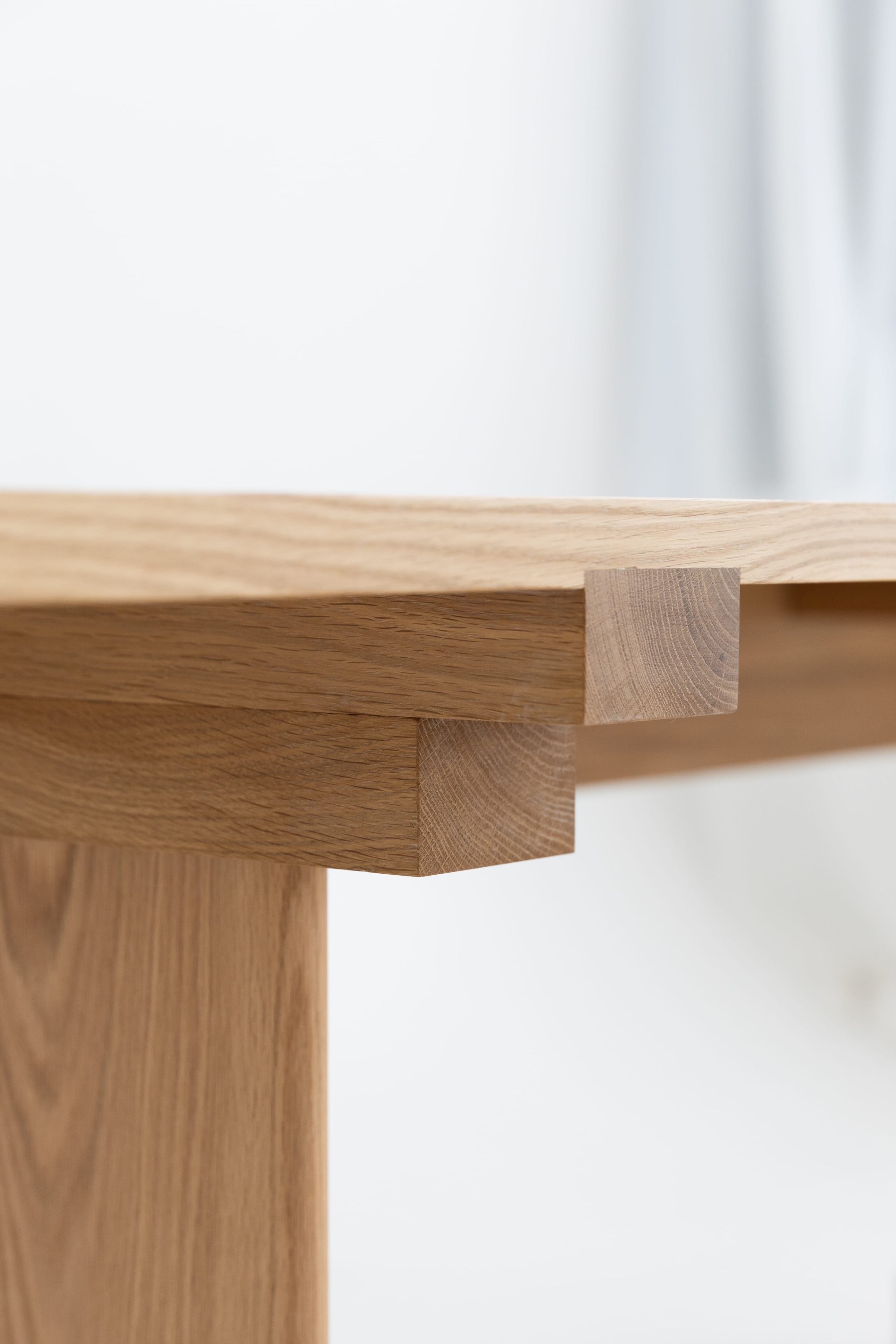
No bevels, no profiling, nothing added whose purpose is to show that work was done. The form is held by proportion and mass alone. Solid oak changes what that severity does — the grain runs where the tree put it, the surface warms under a hand, and the timber moves with the seasons. Concrete does none of that, and the difference is the point.
Made to order in solid oak. Most pieces ship in 4–8 weeks. We ship worldwide. Delivery is quoted separately once we know where the piece is going — within the EU it is typically €100–250 depending on the location.
Design story
Monolith
A monolith is a single mass of stone — no parts, no joins, nothing to read as assembly. A table can never be that. Monolith works toward the impression regardless, and the way it does so comes from a specific kind of building.
Šeškinė is a district on the edge of Vilnius, built in apartment blocks during the last decade of the Soviet period. The designer grew up there, between two sixteen-storey towers. Those towers are not flat-fronted slabs; their facades are dominated by vertical concrete fins that run unbroken from the ground to the roofline, standing proud of the building, with the balconies and windows set back between them. From a distance the tower reads as a row of standing slabs with the living happening behind them.
Nobody admired those buildings. They were the scenery — large, grey, unornamented, sitting on the ground without any interest in being liked. They turned out to be the vocabulary the designer had absorbed before acquiring any other.
Monolith is that structure at the scale of a room. The table stands on vertical slabs of solid oak rather than legs. They carry the top the way the fins carry the tower: not as supports added underneath a surface, but as the primary thing, with everything else arranged around them.
It is also a deliberate move away from Ellipse. Where that table is built from arcs, this one refuses curves entirely. What has been left out matters more than what is present — no bevels, no profiling along the edges, no detail whose function is to demonstrate that the piece was worked on. The form is carried by proportion and mass, which means the proportions have to be right, because there is nothing else to look at.
Scale is the real difficulty. A building can be massive simply because it is large. A table has to suggest mass at a size you can walk around and put your hands on. Too heavy and it becomes something nobody wants to live with; too light and the idea disappears. Most of the work went into that judgement rather than into any single feature — how thick a top has to be before it stops reading as a panel, how much oak a slab needs before it supports something rather than standing beside it.
The material does what concrete cannot. Solid oak has direction: the grain runs where the tree put it, and across a large unbroken surface that is the only incident there is. It warms under a hand. And it moves, expanding and contracting with the seasons for as long as the table exists — a condition the construction has to accommodate rather than resist.
That contrast is the point of the piece rather than a note about its materials. The geometry is severe and the material is not, and both readings arrive at once: from across a room it is a block, and from close up it is timber with a grain you can follow to the end of a board.
There is no quotation of a particular building in it, and no attempt to make the architecture of that period into something romantic. It was housing, and it was ordinary. It is simply where the designer’s sense of what a large form should look like came from — and oak turns out to be a stranger, more forgiving material for the idea than the one those towers were poured from.
Care guide
Monolith
Solid oak is a living material. It takes up and gives off moisture with the seasons and moves slightly as it does — the construction allows for that. A few habits are what keep a piece looking right for decades.
Everyday cleaning. A soft cloth, damp with water, is all it needs. Wipe spills as they happen: oak is porous and standing water will leave a mark. No solvents, no ammonia-based cleaners, no silicone polish — they degrade an oiled finish.
Heat and humidity. Use mats under hot dishes. Aim to keep the room between 40% and 60% relative humidity and avoid rapid swings. A table pushed against a radiator, or standing in a newly built room that is still drying out, will move more than one in a settled space. Underfloor heating is fine; a heat source concentrated on one side is not.
Light. Oak changes colour as it ages. Raw and lightly stained oak ambers over the first year, then settles. Avoid leaving objects in the same spot for months, or you will find a pale rectangle underneath when you move them. Prolonged direct sunlight accelerates all of this.
Re-oiling. Once a year, or whenever the surface starts to look dry or feels rough under the hand. Clean it, let it dry, apply a thin coat of hardwax oil with a lint-free cloth, and wipe off the excess after twenty minutes. No sanding needed.
Marks and dents. This is the advantage of solid timber over veneer: it can be repaired. Light marks come out with fine abrasive paper — 240 grit or finer, worked along the grain — followed by re-oiling, and the repair disappears. For anything deeper, write to us before you start.
Moving it. Lift, do not drag. Carrying a dining table by its top puts the whole load through the joints.
Related products
-

Ellipse Dining Table
Price range: 1 920,00 € through 4 050,00 €Select options This product has multiple variants. The options may be chosen on the product page -

Mid Century Modern Dining Table
Price range: 1 350,00 € through 2 950,00 €Select options This product has multiple variants. The options may be chosen on the product page -

Sculptural Coffee Table – Walnut Tone
900,00 € -

Sculptural Coffee Table – Teak Tone
850,00 €


